Deep foundation systems rely on assumptions about soil behavior, load transfer, and pile performance that cannot be fully confirmed through calculations alone. Even with detailed geotechnical data, uncertainty remains until loads are applied and measured in the field. This makes pile load testing a critical control point in modern foundation engineering.
In 2026, pile load testing plays a more integrated role, particularly for helical pile foundations. Unlike conventional systems where verification occurs late in construction, helical piles embed performance validation into installation through torque monitoring and targeted load testing. This allows engineers to confirm capacity, settlement behavior, and load–displacement response earlier, with greater constructability control.
This guide explains how pile load testing is performed today and how it supports more predictable, risk-managed foundation decisions.
Key Takeaways
Pile load testing remains essential for validating deep foundation performance, confirming capacity, settlement behavior, and soil–pile interaction that cannot be fully resolved through design assumptions alone.
For helical pile foundations, load testing complements torque-based capacity verification, strengthening confidence in load transfer, settlement performance, and long-term behavior while reducing uncertainty earlier in the construction sequence.
Modern load testing evaluates more than ultimate capacity, providing insight into stiffness, creep, and load–displacement response that supports performance-based foundation design rather than conservative overdesign.
Static, dynamic, lateral, and rapid load tests are increasingly combined, allowing engineers to balance verification rigor with site constraints, schedule pressure, and constructability requirements.
When interpreted alongside installation data and geotechnical conditions, pile load testing enables engineers to refine pile geometry, spacing, and acceptance criteria, improving reliability while controlling cost and construction risk.
Pile Load Testing for Helical Piles in 2026
Pile load testing for helical piles is a field-based method used to confirm how installed piles behave under applied loads and whether their performance aligns with design assumptions. Engineers apply controlled forces and measure the pile’s response to verify capacity, settlement behavior, and stiffness under service and ultimate loading conditions.
In 2026, load testing plays a critical role in helical pile foundation engineering because it complements torque-based installation data rather than duplicating it. While installation torque provides immediate insight into soil resistance and capacity development, load testing offers direct confirmation of load–displacement behavior and long-term performance expectations.
Helical pile load testing is commonly used to validate foundation designs for commercial, industrial, energy, and infrastructure projects, particularly where settlement tolerance, uplift resistance, or lateral performance governs design.
Key elements of pile load testing for helical piles include:
Application of controlled test loads: Loads are applied incrementally using hydraulic jacks and reaction systems to replicate real structural demands under compression, tension, or lateral loading.
Measurement of pile movement and settlement: High-precision instrumentation records displacement, rebound, and creep, allowing engineers to evaluate stiffness and serviceability performance.
Evaluation of service and ultimate capacity: Test results confirm whether torque-derived capacity assumptions translate into acceptable load and movement behavior in the ground.
Assessment of helix and shaft interaction: Load testing validates how bearing plates and shaft friction work together, confirming that installation torque accurately reflects in-ground resistance and load transfer mechanisms.
Verification of installation quality: Testing helps identify inadequate embedment, unexpected soil variability, or deviations that may not be evident from installation records alone.
Design optimization and risk reduction: Results are used to refine pile length, helix configuration, spacing, or acceptance criteria, reducing unnecessary conservatism while maintaining performance reliability.
By combining torque-verified installation data with targeted load testing, helical pile foundations in 2026 offer a higher level of performance certainty, enabling engineers to make informed, risk-aware foundation decisions before full-scale construction proceeds.
When load testing is required to validate helical pile performance or refine foundation design assumptions, TorcSill’s engineering team supports test planning, data interpretation, and design integration, helping project teams translate measured behavior into clear, constructible foundation decisions.
The Different Types of Pile Load Testing Used in 2026
Pile load testing is not a single procedure but a group of testing methods selected based on project risk, load demands, soil conditions, and verification requirements. In 2026, testing programs are increasingly tailored to balance accuracy, constructability, schedule impact, and data quality rather than relying on a one-size-fits-all approach.
For helical pile foundations, test selection is often guided by how installation torque, bearing plate engagement, and load path behavior are expected to perform in the field.
Static Pile Load Testing
Static load testing remains the reference standard for confirming pile performance and capacity. Controlled loads are applied incrementally to a test pile while settlement, rebound, and creep are measured over time.
Static testing is commonly used on helical piles to correlate measured load–settlement behaviour with installation torque values, providing direct confirmation that torque-derived capacity assumptions translate into acceptable in-ground performance.
Static testing is typically performed in three configurations:
Compression load testing: Verifies resistance to vertical compressive loads from columns, walls, or equipment. This test is frequently used where settlement limits govern design.
Tension (uplift) load testing: Applied where uplift forces control, such as in transmission structures, tanks, marine works, or wind-governed systems. Uplift testing is particularly relevant for helical piles, where bearing plates provide direct and quantifiable resistance to tensile loads.
Static lateral load testing: Evaluates pile response to horizontal forces from wind, seismic effects, earth pressure, or structural eccentricity. This supports verification of lateral stiffness and allowable deflection limits.
While static load testing provides high-quality performance data, it requires reaction systems, controlled access, and longer testing durations, which must be considered during planning.
Dynamic Pile Load Testing
Dynamic load testing offers a faster and less intrusive method for evaluating pile capacity and installation quality. It involves applying an impact load and measuring stress waves within the pile using instrumentation.
In 2026, dynamic testing is often used for production pile verification and quality control, particularly when calibrated against static test results on selected piles.
Common dynamic approaches include:
High-strain dynamic testing: Uses impact energy sufficient to mobilize significant resistance, allowing estimation of pile capacity, integrity, and resistance distribution.
Rapid load testing: Applies a short-duration load pulse that more closely simulates static behavior while reducing reaction system requirements, making it useful on constrained sites.
Dynamic testing provides valuable comparative data but relies on analytical interpretation and is most effective when used alongside static testing.
Lateral Pile Load Testing
Lateral load testing focuses on pile behavior under horizontal forces and bending. It is commonly used where lateral loads govern foundation performance or where combined loading conditions exist.
This method measures deflection, rotation, and resistance under controlled horizontal loading and is especially relevant for structures exposed to wind, wave action, seismic effects, or operational forces.
Selecting the Appropriate Testing Method
Modern pile load testing programs frequently combine multiple testing methods to balance certainty, efficiency, and constructability. Selection depends on factors such as:
Design load magnitude and sensitivity
Soil variability and geotechnical uncertainty
Code or authority requirements
Access constraints and site conditions
Construction sequencing and schedule risk
For helical pile foundations, testing strategies are often designed to complement torque-based installation data, allowing engineers to validate performance with fewer assumptions and greater confidence early in the foundation lifecycle.
How Engineers Perform Pile Load Testing in 2026
Pile load testing in 2026 follows a structured, engineering-led process designed to confirm foundation performance under controlled conditions. While procedures vary by test type and site constraints, modern testing emphasizes data quality, constructability, and alignment with installation behaviour rather than isolated pass–fail outcomes.
For helical pile foundations, this process is more efficient and more predictable because part of the foundation verification already occurs during installation.
Performing Helical Pile Load Testing: Because helical pile capacity is partially verified during installation, load testing focuses on confirming settlement behaviour and load–displacement response rather than discovering capacity from scratch.
Installation torque provides early insight into soil resistance, allowing engineers to design testing programs around expected performance.
Pre-Test Planning And Test Definition
Engineers begin by reviewing geotechnical data, installation torque records, and structural load demands. For helical piles, torque data informs:
Target test loads and load increments
Expected stiffness and elastic response
Acceptance criteria for settlement and creep
This allows testing to be scoped precisely, avoiding overly conservative setups or unnecessary test durations.
Reaction System Design
Reaction systems are designed to resist applied test loads safely and efficiently. In many helical pile tests, reaction piles are helical piles themselves, installed specifically to resist uplift forces during compression testing.
This approach offers several advantages:
Rapid installation and removal
Minimal site disturbance
Consistent load behaviour aligned with the test pile
Using helical piles as reaction elements simplifies logistics and reduces disruption, particularly on constrained or active sites.
Controlled Load Application
Loads are applied incrementally using hydraulic jacks in accordance with the approved testing protocol. Each load increment is held for a defined duration to observe immediate and time-dependent movement.
During testing, engineers monitor:
Applied load magnitude
Vertical displacement and rebound
Rate of settlement or creep
Because expected capacity is already bracketed by installation data, load application can proceed with greater confidence and control.
Monitoring And Measurement
High-resolution displacement gauges and calibrated load cells are used to capture accurate load–movement behaviour. For helical piles, particular attention is given to:
Initial stiffness under service-level loads
Transition from elastic to non-linear response
Settlement trends relative to torque-based predictions
This data confirms whether installation torque is correlating as expected with in-ground performance.
Data Interpretation And Verification
Following testing, engineers evaluate load–displacement curves to confirm serviceability performance and verify that settlement remains within allowable limits. Rather than redefining capacity, the goal is to validate design assumptions and confirm predictable behaviour under real loading.
Integration Into Foundation Decisions
Test results are then used to:
Confirm acceptance of production piles
Refine pile spacing or embedment where needed
Support design sign-off with measured performance data
For helical pile foundations, this integration between installation records and load testing creates a closed-loop verification process that reduces uncertainty and accelerates foundation approval.
For projects where early performance confirmation, minimal disruption, and constructability control matter, TorcSill supports helical pile load testing strategies that align torque data, test execution, and engineering interpretation into a single, defensible foundation workflow.
What Equipment Engineers Need for Pile Load Testing
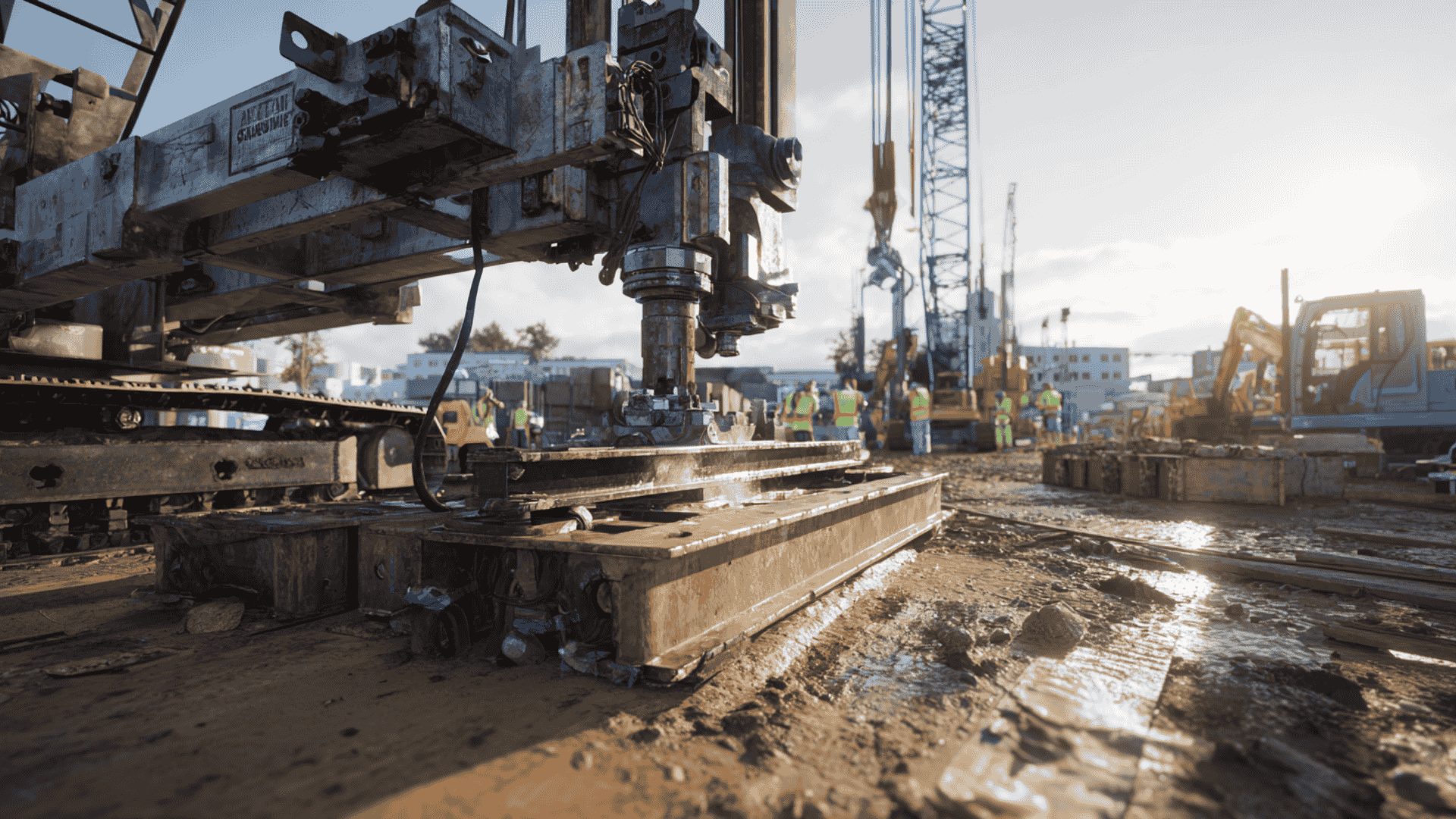
Pile load testing relies on a coordinated set of equipment designed to apply controlled loads and accurately measure pile response under real field conditions. While specific setups vary by test type and site constraints, each component plays a critical role in ensuring safety, data quality, and meaningful interpretation.
Rather than functioning as standalone tools, these elements work together as a temporary structural system that must perform reliably under significant loads.
Test Piles And Installation Equipment
At the center of any load test is the pile being evaluated. For helical pile load testing, the test pile must be installed using the same methods, equipment, and tolerances intended for production piles.
Vertical alignment and installation consistency are critical. Even small deviations can introduce unintended lateral forces during testing, affecting both safety and data accuracy.
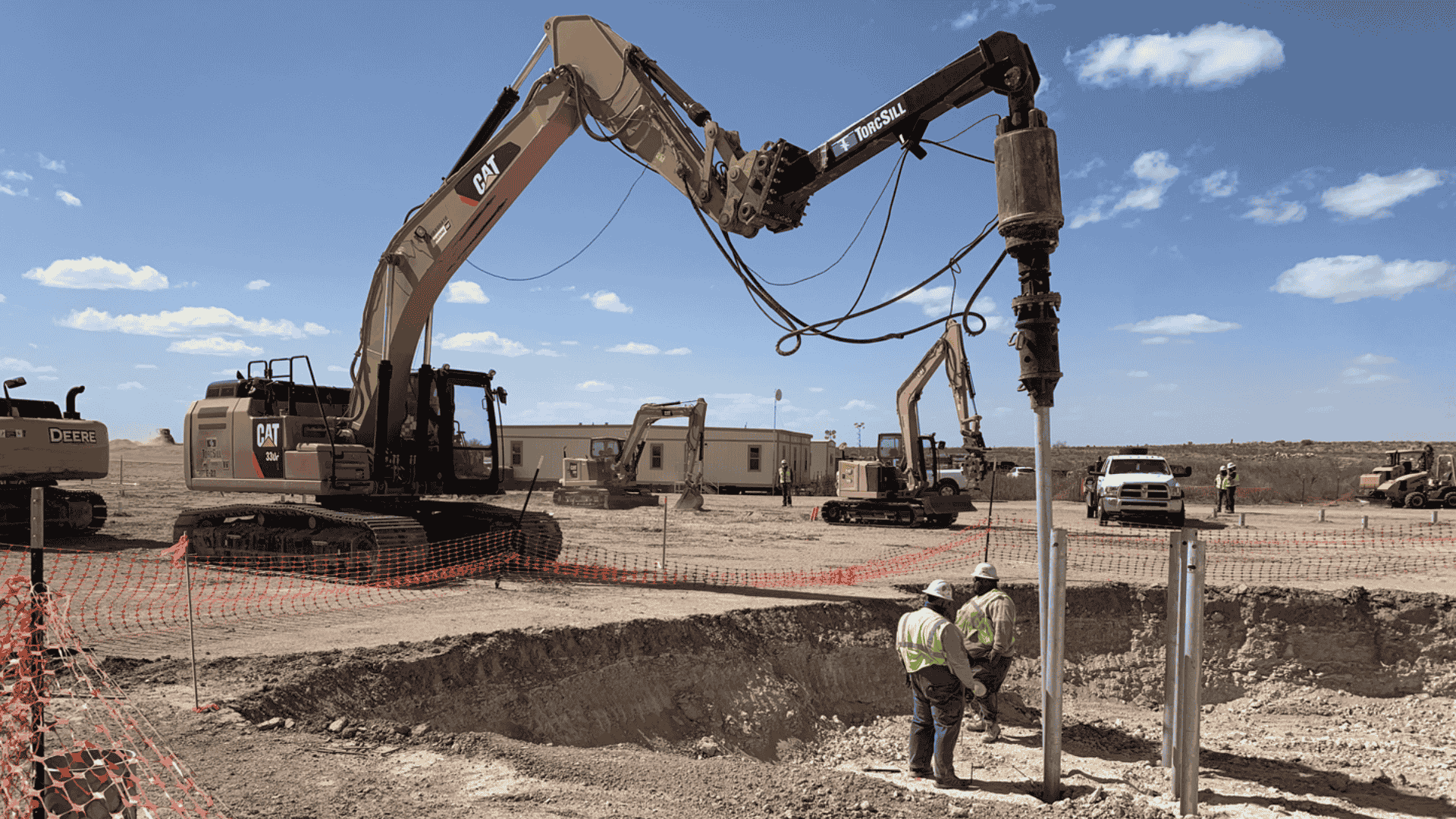
Helical piles are typically installed using excavators, skid steers, or purpose-built rigs equipped with hydraulic drive heads. This allows precise control during installation and enables test piles to be removed after testing where required.
Reaction Piles: Resisting Test Loads
Reaction piles provide the counterforce needed to apply load to the test pile. These piles are installed specifically to resist uplift forces generated by hydraulic jacks during compression testing.
Helical piles are particularly effective as reaction elements because they:
Develop high axial tension resistance
Can be installed quickly and predictably
Are removable, leaving minimal permanent site impact
Using helical piles as reaction elements allows testing systems to be installed, tested, and removed with minimal site impact, an approach TorcSill commonly applies on constrained or active sites where excavation, permanent anchors, or heavy kentledge are impractical.
Load Test Rig And Structural Frame
The load test rig transfers force from the hydraulic jack into the reaction system while maintaining vertical alignment. Rigs are typically assembled from structural steel beams and must remain rigid under load to prevent eccentricity or instability.
Proper alignment of the rig is essential. Misalignment can introduce bending forces that distort results or compromise safety during high-load testing.
Hydraulic Jack And Load Application System
Hydraulic jacks apply load in controlled increments and allow engineers to hold specific load levels for defined durations. This precision supports both short-duration capacity tests and longer maintained-load tests used to evaluate settlement and creep behaviour.
Reliable pressure control and calibrated systems are essential to ensure applied loads match recorded values.
Instrumentation And Measurement Systems
Accurate instrumentation underpins all meaningful load testing. Common measurement systems include:
Load cells to measure applied axial force
Displacement gauges to record settlement or movement
Strain gauges to evaluate load distribution along the pile
Reference beams or independent benchmarks to isolate true pile movement
For helical piles, instrumentation helps confirm that measured performance aligns with expectations based on installation torque and design assumptions.
Data Acquisition And Recording
Modern load testing uses digital data acquisition systems to capture continuous, high-resolution measurements throughout the test. This allows engineers to evaluate behaviour in real time and supports detailed post-test analysis.
By combining controlled loading with precise measurement, engineers can translate field behaviour into defensible performance verification, particularly when load testing is integrated with torque-based installation data.
Best Practices To Follow During Pile Load Testing
Pile load testing applies high forces through temporary systems, often on active or constrained sites. In 2026, best practice focuses on two outcomes: personnel safety and data reliability.
Both are essential for test results to meaningfully inform foundation decisions.
Pre-Test Planning And Controls
Each test begins with a task-specific plan defining load sequences, hold durations, exclusion zones, and emergency procedures. Hazards such as stored energy, reaction instability, and ground movement are identified in advance, with clear roles assigned for load control and monitoring.
Site Safety And Access Management
Access to the testing area is strictly controlled during loading. Exclusion zones are maintained around piles, reaction frames, and jacks, with appropriate barriers, signage, and PPE requirements enforced throughout the test.
Equipment Inspection And Load Application
All hydraulic systems, reaction components, and instrumentation are inspected and calibrated before testing. Loads are applied gradually and only in predefined increments, with continuous monitoring for leaks, misalignment, or unexpected movement. Any abnormal response triggers immediate load reduction.
Operational Discipline And Data Integrity
Testing follows the approved protocol without deviation. Communication between operators and engineers remains continuous, and no personnel are permitted beneath loaded components.
For helical piles, maintaining alignment between installation torque records, pile geometry, and load test measurements is critical. This ensures test results reflect true foundation behaviour rather than setup effects, allowing reliable correlation between torque-based capacity and measured load–settlement response.
Post-Test Stabilization
Loads are released in a controlled manner before dismantling reaction systems and instrumentation. The site is inspected for stability before reopening to general construction activity.
By enforcing disciplined procedures and data consistency, pile load testing delivers reliable performance verification while minimizing safety and schedule risk, particularly for helical pile foundations where installation and testing data are closely linked.
Latest Developments In Pile Load Testing In 2026
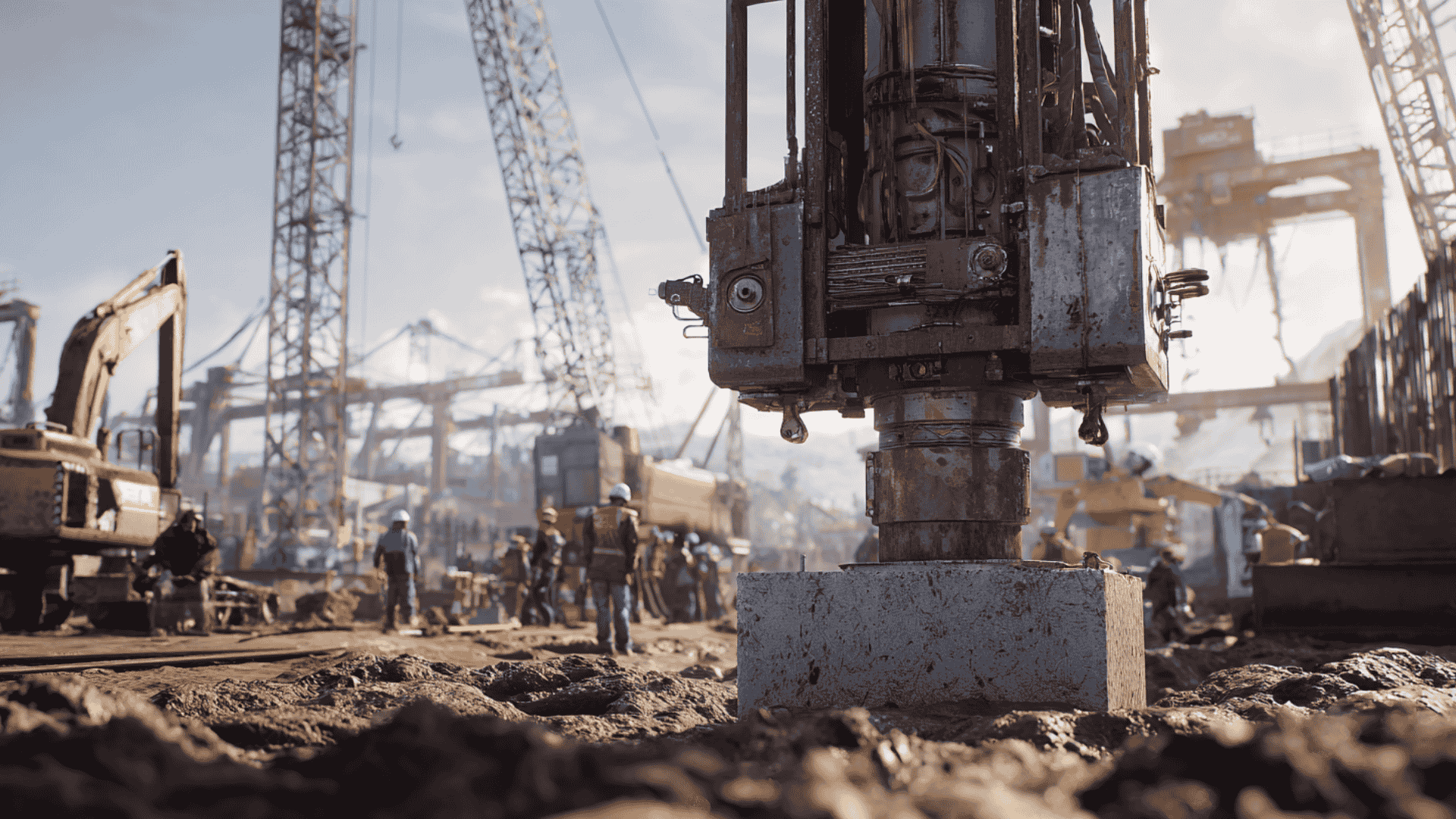
Pile load testing continues to evolve as foundation systems are designed for higher loads, tighter tolerances, and faster construction timelines.
In 2026, innovation is focused less on applying larger loads and more on improving data quality, interpretation, and integration with design assumptions.
Key developments shaping modern pile load testing include:
Real-Time Wireless Instrumentation: Wireless sensors and digital data acquisition systems now provide continuous, real-time monitoring of load, displacement, strain, and movement during testing. This improves data accuracy, reduces manual reading errors, and allows engineers to assess performance while testing is underway rather than after completion.
Advanced Stress-Wave And Signal Analysis: Dynamic and rapid load testing methods benefit from improved stress-wave analysis software. These tools offer clearer insight into load transfer mechanisms, pile integrity, and the balance between shaft resistance and end-bearing behaviour, improving correlation with static performance.
Expanded Use Of Rapid And Intermediate Load Tests: Rapid load testing methods are increasingly used where full static testing is impractical due to space, schedule, or reaction constraints. When properly calibrated, these tests provide reliable stiffness and capacity data with reduced site disruption and shorter test durations.
Integrated Capacity And Integrity Assessment: Modern testing programmes increasingly combine load testing with integrity evaluation. This allows engineers to confirm both structural continuity and load response, reducing the risk of undetected installation defects affecting long-term foundation performance.
Alignment With Performance-Based Design: Pile load testing is now more tightly linked to performance-based foundation design. Test results are used to refine stiffness assumptions, settlement predictions, and serviceability limits, supporting more efficient, site-specific solutions rather than conservative overdesign.
These advances align closely with helical pile foundations, where installation torque data and load testing results can be integrated to refine performance-based design assumptions. By linking measured in-ground behaviour with verified installation parameters, engineers gain earlier confidence in capacity, settlement performance, and long-term reliability.
As testing technologies and interpretation methods continue to advance, pile load testing remains a critical tool for reducing uncertainty and improving confidence in deep foundation performance, particularly for systems designed around verifiable installation and measurable response.
How TorcSill Supports Pile Load Testing Decisions
Pile load testing is most valuable when it is treated as part of a foundation system strategy, not as a standalone verification exercise. In 2026, testing outcomes increasingly influence pile geometry, installation criteria, and construction sequencing, particularly for helical pile foundations where performance can be partially verified during installation.
On energy and industrial projects with variable soils, TorcSill has supported helical pile load testing programmes where torque data and test results were combined to optimize pile lengths before full production installation, reducing uncertainty and avoiding unnecessary overdesign.
TorcSill supports pile load testing decisions through an integrated, engineering-led approach:
Engineering & Design for Tailored Foundation Engineering: TorcSill defines load testing objectives based on project-specific risk, soil behaviour, and helical pile load paths, ensuring tests are designed to confirm performanc, not just meet minimum criteria.
Manufacturing for Quality Helical Piles & Components: Consistent pile geometry, helix configuration, and material quality ensure that test piles accurately represent production piles, allowing test results to be applied confidently across the foundation system.
Construction Services for Site Execution & Installation: Installation torque data is recorded and aligned with load testing protocols, creating a direct link between in-ground resistance, measured performance, and acceptance criteria.
Drilling Services for Site Preparation & Soil Access: TorcSill supports safe, efficient access for test setups, reaction systems, and instrumentation, particularly on constrained or active sites where testing logistics influence feasibility.
Integration With Helical Pile Systems: TorcSill aligns load testing protocols with helical pile installation methods, ensuring testing validates real load paths rather than abstract capacity assumptions.
By connecting installation data, load testing results, and foundation design intent, TorcSill helps project teams turn testing outcomes into actionable decisions, refining pile lengths, spacing, and acceptance criteria before full-scale construction proceeds.
Conclusion
Pile load testing is a critical step in confirming pile capacity, settlement behaviour, and soil–structure interaction under real loading conditions. When planned and interpreted correctly, it reduces design uncertainty and supports reliable foundation performance.
TorcSill provides targeted engineering insight to help teams select appropriate load testing methods and translate test results into clear, defensible foundation decisions.
For commercial and industrial projects, early evaluation of pile load testing data lowers risk, avoids unnecessary conservatism, and supports cost-effective, long-term foundation performance.
Consult a TorcSill engineer to determine how your pile load test results should inform design and construction decisions.
Frequently Asked Questions (FAQs)
1. How many piles typically need to be load tested on a project?
The number of piles tested depends on project scale, ground variability, pile type, and risk tolerance. Many commercial projects test a representative sample rather than every pile, especially where soil conditions are consistent.
2. Can pile load testing be performed on existing structures?
Yes. Load testing can be carried out on selected piles supporting existing structures, provided access allows for test setup and reaction systems. This is often used to verify capacity during renovations or load increases.
3. Does pile load testing always require reaction piles?
Not always. While reaction piles are common for static tests, alternative systems such as kentledge (dead weights) or proprietary test frames may be used depending on site constraints and test type.
4. How long does a pile load test usually take?
Test duration varies by method. Some tests can be completed within a single day, while others may extend over multiple days when load holding periods are required to assess settlement behaviour.
5. What happens if a pile fails a load test?
A failed load test does not automatically mean the project stops. Engineers review the data to understand the failure mechanism and may adjust pile length, diameter, spacing, or overall foundation design to meet performance requirements.