Introduction
Demand for helical pile foundations has surged across US construction, energy, and industrial sectors — driven by projects where soil variability, compressed schedules, and environmental restrictions make traditional concrete piers slow, disruptive, or cost-prohibitive. For these applications, helical piles are now the go-to choice.
Unlike conventional concrete foundations that require excavation, curing time, and spoils disposal, helical piles offer immediate load-bearing capacity, zero soil removal, and proven performance across all soil types — from soft clays to dense rock. That performance advantage makes manufacturer selection a high-stakes decision: the wrong choice affects installation speed, structural longevity, and total project cost.
Not all manufacturers offer the same engineering depth, product range, or field capability. This guide ranks the top 10 US helical pile manufacturers for 2026 — evaluated on product breadth, quality certifications, engineering infrastructure, and proven performance in industrial, energy, marine, and power applications — so you can identify the right partner for your next project.
TL;DR
- Helical piles are steel deep foundation elements installed by rotating them into the ground, serving energy, construction, marine, and infrastructure sectors
- The US market includes pure manufacturers and vertically integrated firms handling design, fabrication, and installation
- Selection criteria include product range, engineering support, certifications (ISO, ICC-ES, AWS), geographic reach, and sector experience
- TorcSill tops the list: ISO 9001:2015 certified, licensed in 23 states, with 40+ years of global project experience
- The remaining nine include Hubbell Power Systems, MacLean, Ram Jack, ECP, Foundation Supportworks, GoliathTech, and others covered in the full rankings below
What Are Helical Piles and Why Do They Matter in US Construction?
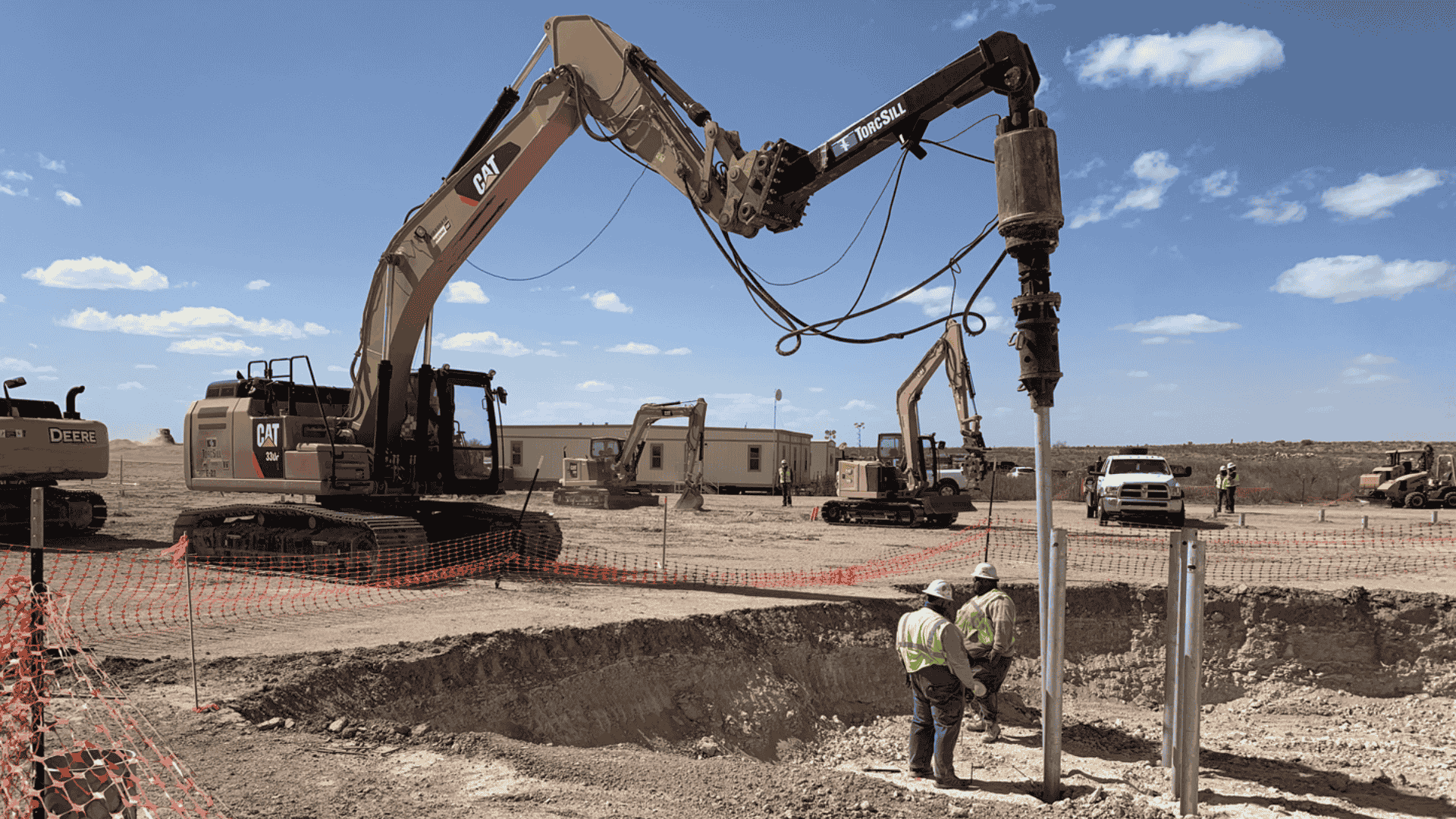
Helical piles (also called helical piers or screw piles) are factory-manufactured steel foundation systems consisting of a central shaft with one or more helical-shaped bearing plates. They're installed by applying torque to screw the pile into the ground until reaching the desired depth or bearing stratum, functioning as both piles (compression) and anchors (tension) depending on configuration.
The North American helical pile market is projected to reach $392.6 million by 2030, growing at a CAGR of 4.3%. Demand spans multiple high-growth sectors:
- Oil and gas — projected to reach $513.46 million by 2032
- Solar energy — projected to reach $1.43 billion by 2034
- Utility transmission, marine structures, and industrial facilities

That growth creates a crowded supplier landscape. US manufacturers differ substantially in product range, helix configurations, shaft types (round vs. square), and whether they provide engineering support or turnkey installation — differences that directly affect schedule, cost, and load performance on your project.
Top 10 Helical Pile Manufacturers in the US (2026)
Choosing the right helical pile manufacturer affects project timelines, load performance, and code compliance. The companies below were selected based on product range, engineering capability, certifications, and proven track record on complex or large-scale US projects.
TorcSill Foundations
TorcSill is a Houston, TX-based vertically integrated helical pile manufacturer and installer with more than 40 years of global project experience across offshore/onshore energy, industrial, marine, and power sectors. Operating from 14 US locations and licensed in 23 states, TorcSill delivers end-to-end solutions from engineering through installation.
- ISO 9001:2015 and AWS D1.1 certified manufacturing facility
- Over 50 installation spreads and 100+ drive tools enabling rapid mobilization
- Vertically integrated model: engineering, manufacturing, and installation under one provider
- No spoils, no vibration, CO2 reduction of up to 50% compared to concrete
- Immediate load capacity upon installation
| Attribute | Details |
|---|---|
| Product/Service Scope | Helical piles (TorcSills) for energy, industrial, power, and marine applications; manufacturing + installation; global and US operations |
| Certifications | ISO 9001:2015, AWS D1.1 shop; licensed in 23 US states |
| Key Differentiator | Vertically integrated model—engineering, manufacturing, and installation under one provider; immediate load capacity; low environmental impact |

Hubbell Power Systems (AB Chance)
Hubbell Power Systems (Centralia, MO) has manufactured helical products under the AB Chance brand since 1912, making it the longest-running helical pile name in the US. The product line covers both round corner square (RCS) and round shaft options across residential, commercial, and utility markets, with ICC-ES ESR-2794 certification reissued in January 2026.
- Broad product range: 1.25 in. to 8.625 in. shaft options
- ICC-ES AC358 certified products with strong code compliance track record
- Extensive distributor and installer network nationwide
- Deep presence in utility/transmission applications including environmentally sensitive tower foundations
| Attribute | Details |
|---|---|
| Shaft Types Offered | RCS (1.25 in. to 2.25 in.) and round shaft (2.875 in. to 8.625 in.) |
| Certifications | ICC-ES ESR-2794 (reissued January 2026) under AC358 |
| Key Markets | Utility, transmission, residential, commercial construction |
MacLean Power Systems – Civil Products (MPS Civil)
MacLean Power Systems (Fort Mill, SC) manufactures both RCS and round shaft helical products, distinguished by a patented male-female square engagement coupling system designed to reduce bolt-hole elongation during installation. The company holds ICC-ES ESR-3032 certification (reissued August 2025).
- Patented coupling technology improves connection stability under torque
- Engineering support for dealer network
- Specialty products for highway signage, solar, and pipeline applications
- Strong utility anchoring heritage
| Attribute | Details |
|---|---|
| Shaft Types Offered | RCS (1.50 in. to 1.75 in.) and round shaft (2.875 in. to 3.50 in.) |
| Notable Technology | Patented male-female coupling system; reduced installation torque stress on fasteners |
| Key Markets | Utility, solar, highway infrastructure, pipeline |
Ram Jack Systems Distribution
Ram Jack (Ada, OK) is a manufacturer and installer with over 60 franchise locations nationwide. The company holds ICC-ES ESR-1854 certification and distinguishes itself by offering threaded coupling options (in addition to bolted) and polymer coating as a standard corrosion protection option per ICC-ES AC 228 criteria.
- Wide franchised installation network across the US
- Polymer coating standard on products for enhanced corrosion protection
- Specialty in foundation repair and underpinning markets
- Comprehensive dealer support infrastructure
| Attribute | Details |
|---|---|
| Shaft Types Offered | Round shaft (2.875 in. to 3.50 in. standard); RCS by special order |
| Corrosion Protection | Polymer coating (standard per ICC-ES AC 228), hot-dip galvanizing |
| Key Markets | Foundation repair, underpinning, residential and light commercial |
Earth Contact Products (ECP)
ECP (Olathe, KS) manufactures both RCS and round shaft helical products as stocking items, serving foundation repair contractors, dealers, and installers across the US residential and light commercial segments. The company holds ICC-ES ESR-3559 certification.
- 4 RCS products (1.50 in. to 2.25 in.) and multiple round shaft options as standard stock
- Dealer/contractor distribution network for fast availability
- Serves foundation repair, utility T&D, solar, and oil & gas pipeline markets
| Attribute | Details |
|---|---|
| Shaft Types Offered | RCS (1.50 in. to 2.25 in.) and round shaft (2.875 in. to 4.50 in.) |
| Distribution Model | Dealer/contractor distribution network across the US |
| Key Markets | Foundation repair, underpinning, residential construction, utility, solar |
Foundation Supportworks (FSI)
FSI (Omaha, NE) operates a dealer-based distribution model, offering RCS and round shaft helical piles primarily for residential foundation repair and new construction markets. The company provides engineering support for installer networks and maintains ICC-ES certification.
- Strong dealer support infrastructure including engineering resources
- ICC-ES certified products evaluated under AC358
- Product line from 2.375 in. to 4.50 in. round shaft
- Focus on residential and light commercial foundation stabilization
| Attribute | Details |
|---|---|
| Shaft Types Offered | Round shaft (2.375 in. to 4.50 in. OD) with varying wall thicknesses |
| Certifications | ICC-ES certified under AC358 |
| Key Markets | Residential and light commercial foundation repair, new construction |
IDEAL Foundation Systems (IDEAL Group)
IDEAL Group (Webster, NY) manufactures round shaft helical piles with ICC-ES ESR-3750 certification (reissued June 2024). The company serves heavy industrial, marine, and large-scale infrastructure applications requiring robust pile configurations.
- Engineering support for large-diameter pile design
- ICC-ES certified products for code compliance
- Specialty in heavy commercial, marine, and industrial projects
- Custom pile configurations for demanding load requirements
| Attribute | Details |
|---|---|
| Shaft Types Offered | Round shaft (2.875 in. to 3.50 in. OD) and RCS (1.50 in.) |
| Certifications | ICC-ES ESR-3750 (reissued June 2024) |
| Key Markets | Heavy industrial, marine, large-scale infrastructure, commercial |
GoliathTech
GoliathTech operates significant US operations through a nationwide franchise installer network. The company specializes in round shaft helical piles with ICC-ES ESR-3726 certification (reissued October 2024, revised April 2025), offering standardized products for residential through mid-size commercial applications.
- Franchise-based installation model enabling wide US coverage
- Standardized installation training across franchise network
- ICC-ES certified product line
- Strong presence in residential, light commercial, and solar markets
| Attribute | Details |
|---|---|
| Shaft Types Offered | Round shaft only (2.375 in. to 3.50 in. per ICC-ES ESR-3726) |
| Distribution Model | Franchise installer network across the US |
| Key Markets | Residential, light commercial, solar, deck/structure foundations |
Helical Anchors, Inc. (HAI)
HAI (Minneapolis, MN) manufactures one of the broadest round shaft product selections among US makers, with ICC-ES ESR-3982 certification (reissued September 2025). The company offers 11+ standard pile sizes from 2.375 in. to 12.75 in., including specialty 5.00 in. and 5.50 in. sizes not commonly available from competitors.
- Widest mid-range diameter selection (11+ standard sizes) for specialized load requirements
- Engineering support for installers and contractors
- Specialty sizes (5.00 in. and 5.50 in.) not commonly stocked by competitors
- Competitive pricing on specialty configurations
| Attribute | Details |
|---|---|
| Shaft Types Offered | Round shaft only (2.375 in. to 12.75 in.); includes 5.00 in. and 5.50 in. specialty sizes |
| Notable Offering | Widest mid-range diameter selection for custom/specialized load requirements |
| Key Markets | Commercial, industrial, specialty deep foundation applications |
Magnum Piering
Magnum Piering (Cincinnati, OH) manufactures helical pier and push pier systems serving foundation repair, residential, and light commercial markets through a dealer/contractor distribution model. The company holds ICC-ES ESR-2997 certification (reissued May 2025) and ISO 9001 accreditation.
- ISO 9001 quality management system
- Combined helical and push pier product lines (a differentiator among residential-focused manufacturers)
- Dealer/contractor network across the US
- Transition pile technology with large-diameter top segments
| Attribute | Details |
|---|---|
| Products Offered | Helical piers and push pier systems; round and square shaft configurations |
| Distribution Model | Dealer/contractor network across the US |
| Key Markets | Foundation repair, underpinning, residential and light commercial |
How We Chose the Best Helical Pile Manufacturers
Manufacturers were evaluated on a combination of product range (shaft types, diameters, helix configurations), quality certifications (ISO, ICC-ES, AWS), engineering support infrastructure, US geographic coverage, and demonstrated performance in demanding sectors—not just name recognition or market longevity.

A common mistake: selecting on price or brand familiarity alone, without confirming the manufacturer can support the full project lifecycle—from load analysis and pile design through installation and post-install load testing.
For industrial, energy, and infrastructure projects specifically, the distinction between manufacturers-only versus vertically integrated providers (who also manage installation) is a critical factor that directly impacts:
- Project schedule and mobilization speed
- Single-point accountability for design and installation
- Quality control throughout the entire process
- Engineering responsiveness to field conditions
The manufacturers on this list were selected because they perform across all of these dimensions—not just one or two.
Conclusion
The right helical pile manufacturer is the one whose product range, engineering depth, and installation capability match your project's specific demands—not just the one with the broadest name recognition.
Before finalizing a supplier, assess total project value: lead time, engineering responsiveness, field support, quality certifications, and scalability for future phases. For complex projects, vertically integrated providers eliminate coordination gaps between design, manufacturing, and installation—compressing schedules and reducing risk.
If your project falls within the energy, industrial, marine, or power sectors, TorcSill brings 40+ years of project experience, ISO 9001:2015 manufacturing, and 14 construction operations locations across the US. Contact TorcSill at [email protected] or (800) 731-8672 to discuss your project requirements.
Frequently Asked Questions
How much do helical pilings cost?
Helical pile costs range from $2,000–$4,000 per pier installed for foundation repair and $300–$500 per pier for deck installations, with materials running $15–$30 per linear foot. Total installed cost varies by shaft diameter, helix count, depth, soil conditions, and whether engineering and load testing are included—making it the more relevant metric than material price alone.
What is the lifespan of a helical pile?
Properly designed and installed helical piles—particularly hot-dip galvanized or polymer-coated steel—can last 75 to 150+ years depending on soil corrosivity, steel grade, and coating. ICC-ES AC358 requires capacity calculations to account for corrosion over a 50-year design life, with longer service achievable through appropriate protection in mildly corrosive soils.
What is the best helical pile?
Shaft type (RCS vs. round shaft), load requirements, and soil conditions determine the right pile for any given project. For heavy industrial or energy applications, a vertically integrated provider like TorcSill—handling engineering, ISO 9001:2015 manufacturing, and installation under one roof—delivers the most reliable outcome by keeping design, fabrication, and load testing on a single contract.
Who manufactures helical piers?
The US market includes both pure manufacturers (ECP, IDEAL, HAI) and vertically integrated providers that manufacture and install (TorcSill, Ram Jack, GoliathTech). Buyers should confirm whether the company provides engineering support and installation services or only supplies product, as this distinction significantly impacts project schedule, quality control, and accountability.
What are helical piles used for?
Common applications span new construction foundations, foundation repair, earth retention, pipeline and utility anchoring, solar arrays, marine structures, and industrial/energy infrastructure. Immediate load capacity and compatibility with soils ranging from soft clays to dense rock make them a practical choice where speed and low site disturbance matter.
How do helical piles compare to concrete piers?
Helical piles require no concrete (eliminating curing time and CO2 from cement production), produce no soil spoils, can bear load immediately after installation, and can be removed/reused for temporary structures. Research indicates helical piles can reduce CO2 emissions by approximately 56% compared to bored concrete piles, making them faster and often more cost-effective than cast-in-place concrete alternatives.