Foundation selection is one of the most critical decisions in any construction or infrastructure project. The right system directly affects structural performance, construction schedules, long‑term maintenance costs, and overall project risk.
The U.S. construction industry continues to grow, with total construction put‑in‑place at $2.23 trillion in 2025, reflecting ongoing demand in residential, non‑residential, and infrastructure sectors.
For decades, concrete foundations have been the default solution across commercial, industrial, and infrastructure projects in the United States. However, modern site constraints, tighter schedules, labor shortages, and growing sustainability expectations are forcing engineers and developers to reassess traditional approaches.
According to recent market research, the screw piles (helical piles) industry is projected to grow to more than $3.5 billion by 2035. Additionally, helical pile foundation solutions for poles and utility infrastructure are expected to reach $2.39 billion by 2033.
This guide provides a clear, technical comparison of helical piles vs. concrete foundations, examining how each system performs across key criteria.
Key Takeaways:
Helical piles install rapidly with minimal excavation, delivering immediate load capacity, reduced site disruption, and predictable performance in complex U.S. projects.
Concrete foundations remain suitable for large, permanent structures but require excavation, curing time, extensive labor, and weather-dependent scheduling.
Helical piles adapt to variable soils, high groundwater, and restricted sites, while concrete often demands soil improvement or additional structural measures.
Total lifecycle costs favor helical piles due to fewer delays, lower maintenance, reusability potential, and reduced hidden expenses from spoils or rework.
Environmentally, helical piles produce less carbon, minimal soil disturbance, and align with sustainability goals, whereas concrete generates higher embodied emissions.
Understanding Foundation Systems
Selecting the right foundation system starts with understanding how different technologies work, how they interact with soil conditions, and where each approach delivers the most value.
What Are Helical Piles?
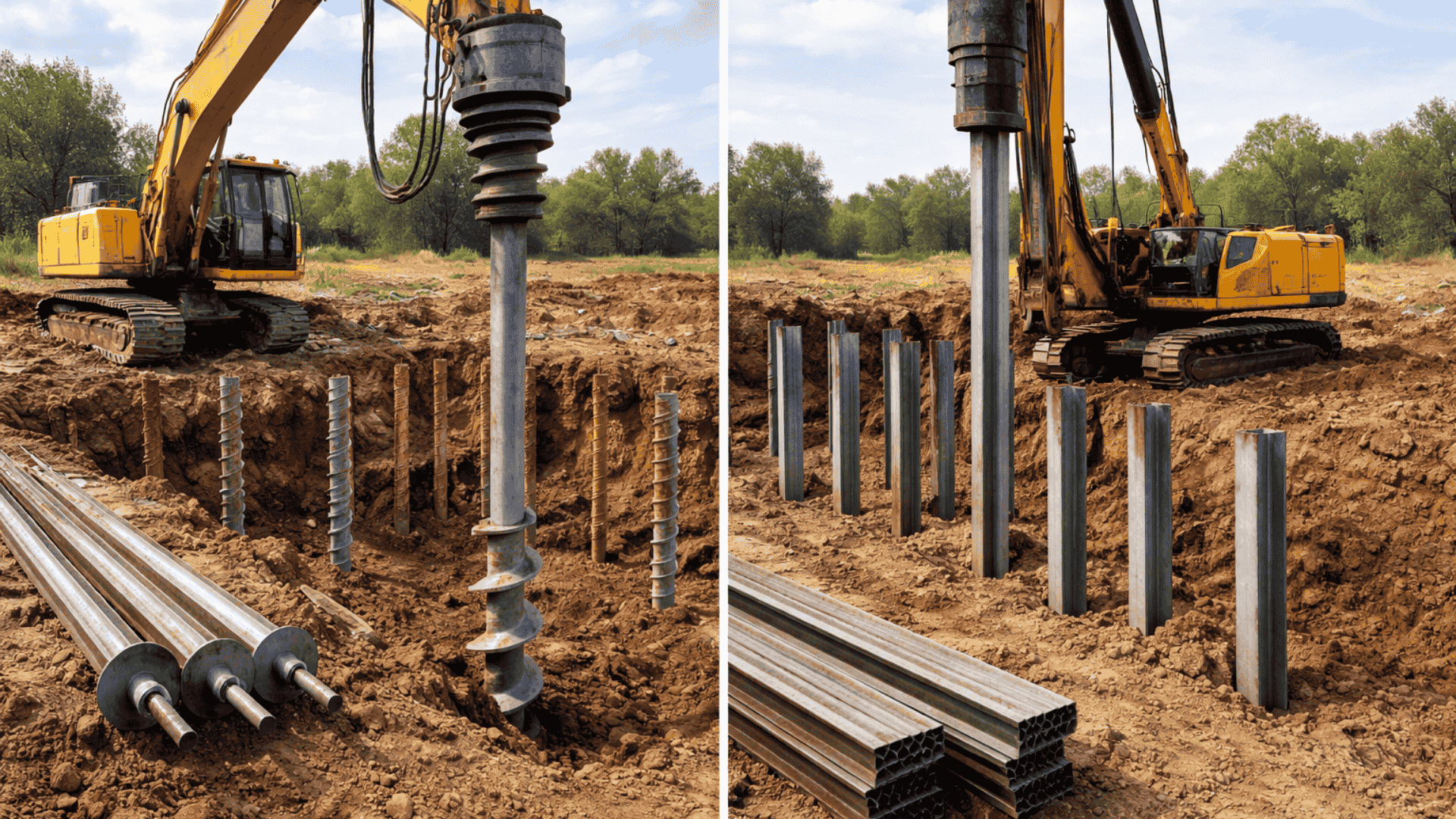
Helical piles, also known as helical piers or screw piles, are deep foundation elements made of high-strength steel shafts fitted with one or more helical bearing plates. These plates are engineered to match site-specific soil conditions and load requirements.
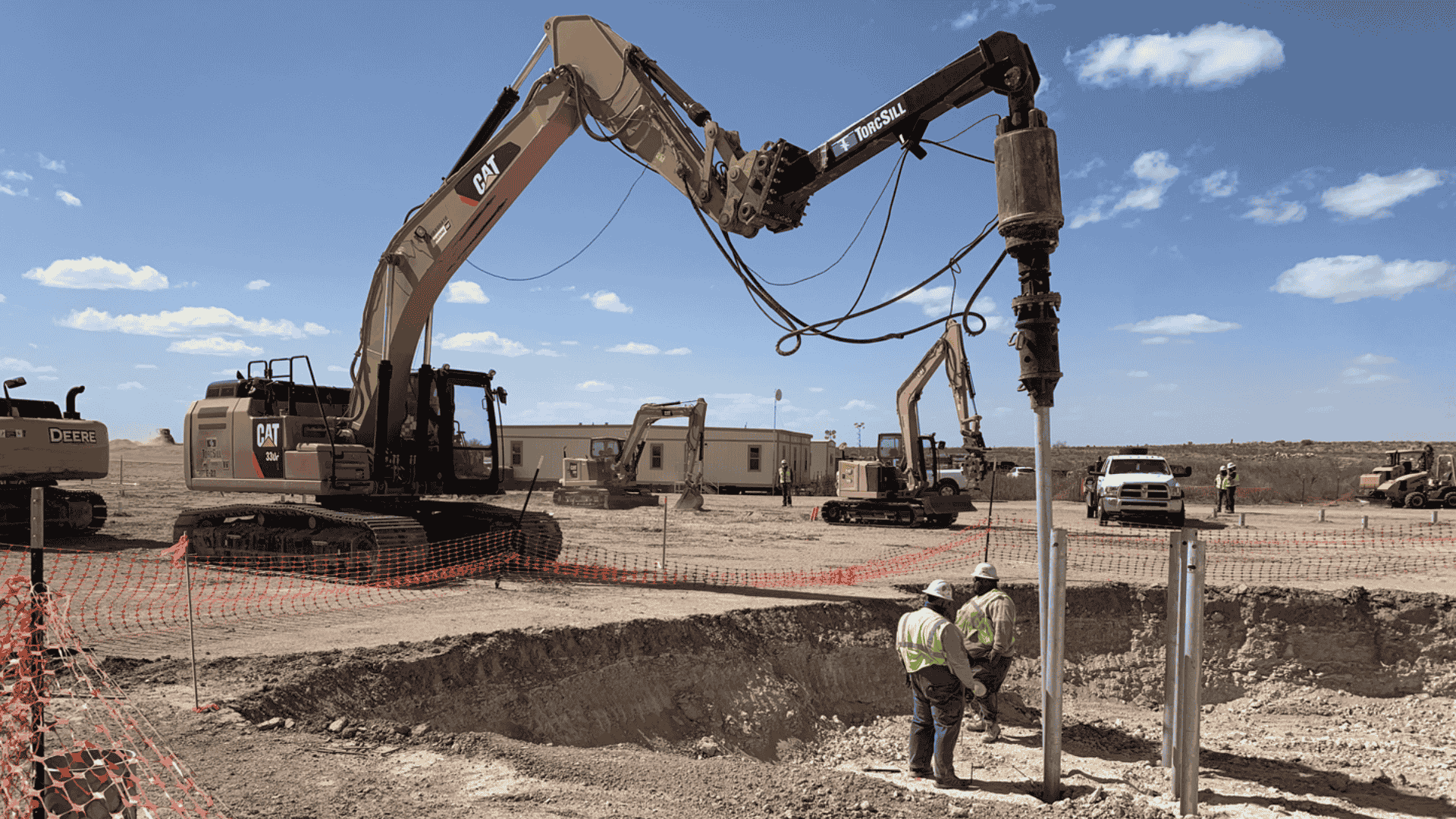
Helical piles are installed by rotating them into the ground using hydraulic torque motors. As the pile advances, the helical plates engage the surrounding soil, creating a mechanical load-bearing system. The applied installation torque is directly correlated to soil strength, allowing engineers to verify capacity in real time during installation.
Rather than relying on end bearing alone, helical piles transfer load through a combination of:
Bearing resistance from the helical plates
Shaft resistance along the steel pile
Embedment into competent soil strata
Because installation does not require excavation or concrete placement, helical piles generate minimal spoils, vibration, or noise. Once installed, they can be loaded immediately, eliminating curing time and enabling faster construction sequencing.
What Are Concrete Foundations?
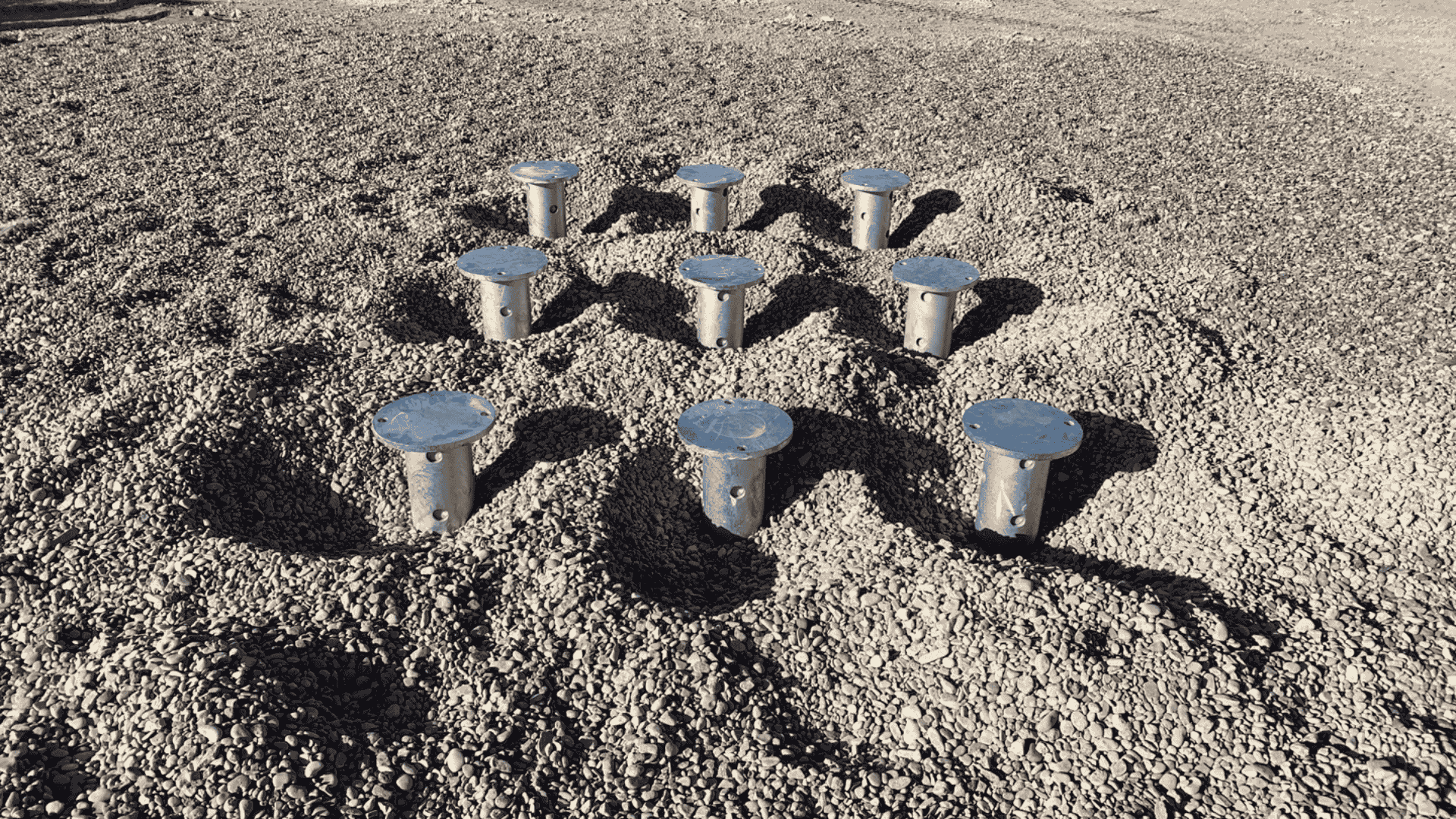
Concrete foundations encompass a broad range of shallow and deep foundation systems that rely on cast-in-place or precast concrete to distribute structural loads into the soil. These systems have been the backbone of construction in the United States for generations due to their familiarity and versatility.
Concrete foundations are generally categorized as:
Shallow foundations, which distribute loads near the surface when soils are competent:
Spread footings
Strip footings
Mat or raft foundations
Deep foundations, used when surface soils cannot support design loads:
Drilled shafts (caissons)
Cast-in-place concrete piles
Precast concrete piles
Installation typically involves excavation, formwork, reinforcement placement, and concrete pouring. For deep foundations, drilling or driving operations are required, followed by concrete placement and curing. Unlike helical piles, concrete foundations depend heavily on soil conditions, weather, and quality control during placement.
Installation Process: Helical vs. Concrete Foundations
The installation process is one of the most significant differentiators between helical piles and concrete foundations.
Helical Pile Installation
Helical piles are installed using hydraulic rotary equipment that applies controlled torque to advance the steel pile into the ground. The process is fast, precise, and requires minimal site preparation.
Key characteristics of helical pile installation include:
Torque-installed steel piles: Each pile is rotated into the soil to a predetermined depth and torque value, which correlates directly to load capacity. This allows for real-time verification of performance during installation.
No excavation or spoils: Because the piles are screwed into the ground, there is no need for digging, soil removal, or disposal. This significantly reduces site cleanup and environmental impact.
Minimal vibration and noise: Installation produces little to no vibration, making helical piles well-suited for urban environments, operating facilities, and sites near sensitive structures or equipment.
Immediate load capacity: Once installed, helical piles can be loaded immediately. There is no curing time, enabling faster foundation-to-superstructure transitions.
Adaptability in the field: If subsurface conditions differ from geotechnical assumptions, pile depth or configuration can be adjusted during installation without redesign or delays.
Helical pile installation is particularly advantageous on U.S. projects with tight schedules, limited access, high groundwater, or ongoing operations where disruption must be minimized.
Concrete Foundation Installation
Concrete foundation installation is a multi-step process that typically involves several trades, heavy equipment, and strict sequencing requirements. The complexity increases significantly for deep foundation systems.
Common steps in concrete foundation installation include:
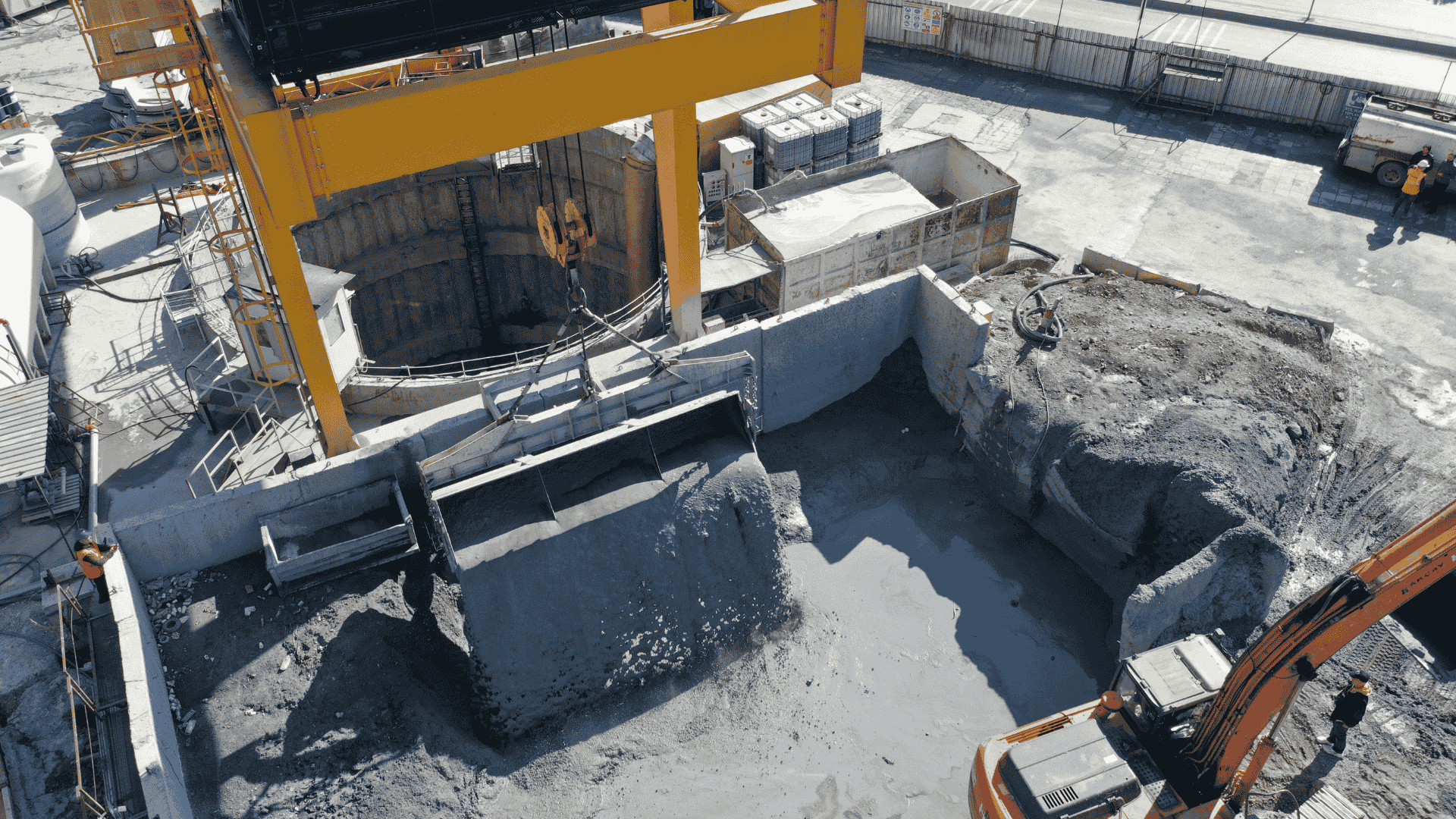
Excavation and drilling: Shallow foundations require open excavation, while deep foundations involve drilling or driving operations. These steps often generate large volumes of spoils that must be managed or hauled off-site.
Formwork and reinforcement placement: Concrete foundations require formwork and rebar installation, increasing labor demands and coordination between crews.
Concrete placement and finishing: Concrete must be poured, consolidated, and finished under controlled conditions. Quality can be affected by weather, access limitations, and workmanship.
Curing time and strength gain: Concrete requires days or weeks to reach design strength. During this period, foundation elements cannot be fully loaded, potentially delaying downstream construction activities.
Weather and groundwater limitations: Rain, freezing temperatures, or high groundwater tables can disrupt excavation and pours, requiring dewatering, thermal protection, or schedule adjustments.
Concrete installation often results in greater site disruption, longer timelines, and increased exposure to delays, particularly on projects with complex logistics or aggressive schedules.
Cost Comparison: Helical Piles vs. Concrete
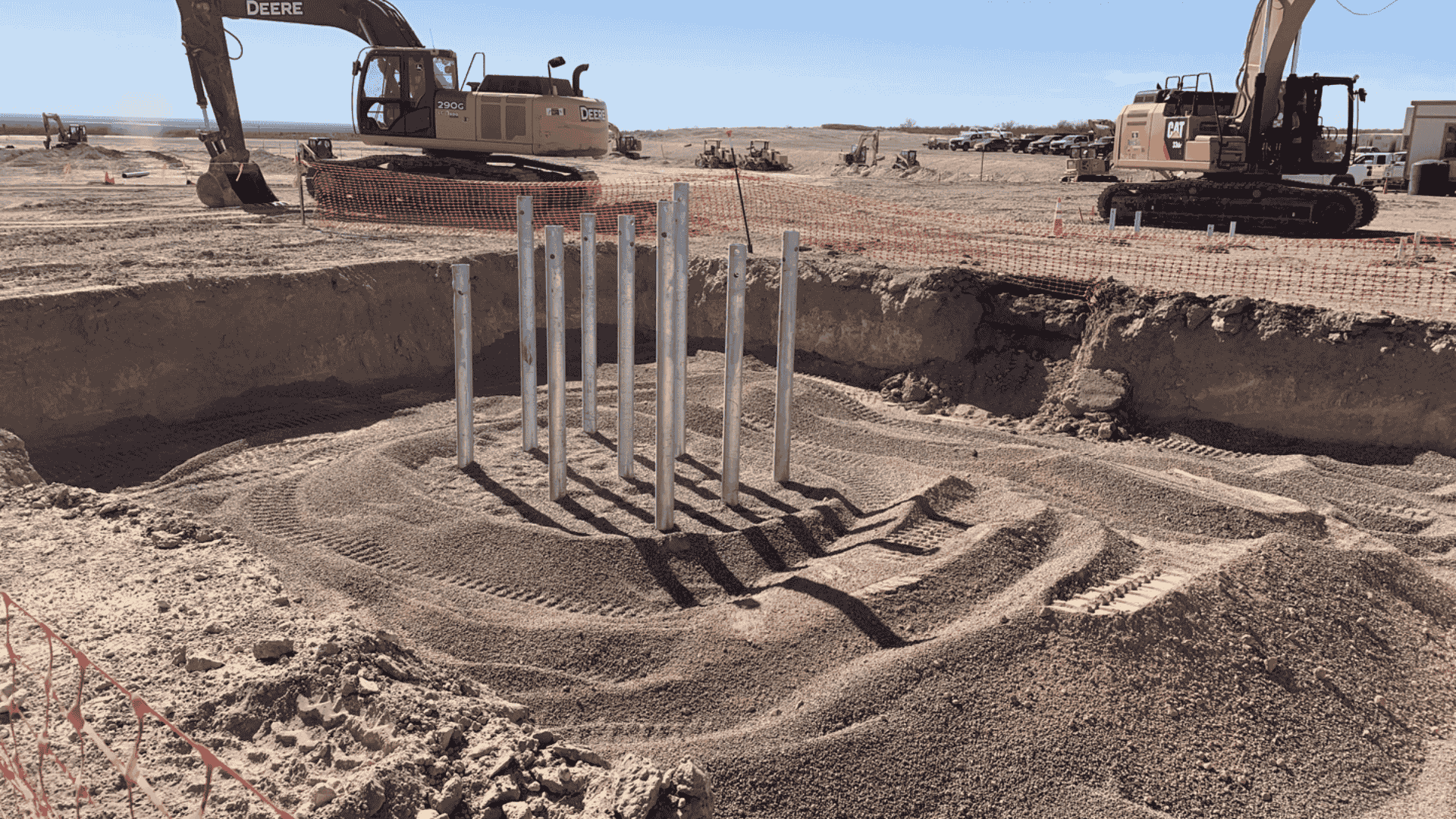
Cost is often a deciding factor in foundation selection, but focusing solely on upfront material pricing can be misleading. A meaningful comparison between helical piles and concrete foundations must consider total installed cost, schedule impacts, and long-term financial risk.
Upfront Material and Installation Costs
Concrete foundations are often perceived as the lower-cost option due to the relatively low price of raw materials. However, installed costs can increase quickly due to:
Excavation and spoils removal
Formwork and reinforcement
Multiple labor crews and equipment
Concrete placement and finishing
Helical piles, by contrast, typically have higher per-unit material costs, but installation is streamlined. The system combines foundation elements, installation, and verification into a single operation, often reducing overall installed cost on complex sites.
Labor and Equipment Requirements
Concrete foundations require:
Excavators or drilling rigs
Formwork crews
Rebar installers
Concrete trucks and finishing teams
Quality control and inspection personnel
Helical pile installation generally requires:
A small installation crew
Hydraulic torque equipment
Minimal support equipment
Fewer trades and simpler logistics often translate to lower labor risk and better cost predictability, particularly in U.S. markets facing skilled labor shortages.
Schedule-Related Cost Savings
Time is money on construction projects. Helical piles can reduce costs associated with:
Extended general conditions
Equipment standby time
Weather-related delays
Accelerated schedules or liquidated damages
Concrete foundations, with their longer installation and curing timelines, can increase indirect costs even when direct material costs appear lower.
Lifecycle Cost Considerations
Lifecycle costs extend beyond initial construction and include:
Maintenance requirements
Performance reliability
Risk of settlement or remediation
Future modifications or removals
Helical piles offer advantages such as:
Predictable performance
Minimal long-term maintenance
Potential reusability or removal
Concrete foundations may require monitoring or repairs if settlement, cracking, or environmental degradation occurs over time.
Performance in Challenging Site Conditions
Many U.S. infrastructure and industrial projects are located on sites with geotechnical, environmental, or logistical constraints that complicate traditional foundation construction. In these conditions, foundation performance is as much about constructability as it is about structural capacity.
Soft or Variable Soils
Sites with soft clays, loose sands, or highly variable soil profiles present significant challenges for conventional concrete foundations. Shallow systems may require over-excavation or soil improvement, while deep concrete foundations can demand larger diameters or increased embedment.
Helical piles are well-suited for these conditions because they:
Bypass weak surface soils
Transfer loads to deeper, more competent strata
Allow field adjustments based on real-time installation torque
Reduce the need for conservative overdesign
This adaptability improves reliability in variable subsurface conditions.
High Groundwater Tables
High groundwater complicates excavation, drilling, and concrete placement. Dewatering operations add cost, increase environmental risk, and can disrupt nearby structures.
Helical piles perform effectively in high groundwater environments because:
No open excavation is required
Installation is not impacted by water inflow
No concrete placement below the water table is needed
This makes helical piles a practical solution for coastal regions, flood-prone areas, and sites near rivers or lakes.
Coastal and Marine Environments
Coastal and marine projects face additional challenges, including corrosion exposure, tidal influences, and limited access.
Helical piles are commonly used in these environments due to:
Small installation footprints
Reduced disturbance to marine sediments
Compatibility with corrosion protection systems
Ability to install from barges or restricted platforms
Concrete foundations in marine settings often require complex formwork, cofferdams, or tremie pours, increasing risk and cost.
Remote or Access-Restricted Sites
Projects in remote locations or congested urban areas often struggle with access for large drilling rigs, concrete trucks, and excavation equipment.
Helical piles can be installed using compact, modular equipment that:
Requires less staging area
Reduces mobilization complexity
Supports faster setup and demobilization
This advantage is particularly valuable for utility upgrades, substations, and retrofits.
Brownfield and Environmentally Sensitive Locations
Brownfield sites may contain contaminated soils, buried obstructions, or environmental restrictions that limit excavation.
Helical piles aew often preferred over excavation-intensive concrete foundations on sensitive sites because they:
Generate minimal spoils
Reduce exposure to contaminated materials
Minimize permitting complexity
Design Flexibility and Adaptability
Modern construction projects rarely unfold exactly as planned. Subsurface variability, design changes, and evolving project requirements demand foundation systems that can adapt without causing delays or cost overruns. In this area, helical piles offer a level of flexibility that traditional concrete foundations often cannot match.
Custom Engineered Helical Pile Designs
Helical piles are not one-size-fits-all solutions. Each system is engineered based on:
Site-specific geotechnical data
Structural load requirements
Axial, lateral, and uplift demands
Environmental and corrosion considerations
Pile shaft size, helix diameter, spacing, and configuration can all be tailored to meet project needs. This engineered approach allows helical piles to be optimized rather than overbuilt.
Adjustability in the Field
One of the most significant advantages of helical piles is their adaptability during installation. If subsurface conditions differ from geotechnical assumptions, installers can:
Advance piles to greater depths
Add extensions without redesign
Adjust installation torque targets
Modify pile layouts with minimal disruption
These adjustments can be made in real time, preserving the schedule and performance.
Concrete foundations, by contrast, are far less forgiving. Unexpected conditions often require redesign, additional excavation, or rework, each with cost and schedule implications.
Modifications During Construction
Design changes during construction are common, especially on fast-track or phased projects. Helical pile systems accommodate changes such as:
Revised load demands
Equipment relocation
Structural layout adjustments
Because piles can be installed individually and verified immediately, changes are easier to incorporate without impacting the entire foundation system.
Accommodating Future Expansions or Relocations
Helical piles provide flexibility beyond initial construction. They can be:
Supplemented with additional piles for future load increases
Removed or relocated for temporary structures
Integrated into phased development plans
Concrete foundations are permanent and difficult to modify, often limiting adaptability over the life of a facility.
Typical Applications and Use Cases
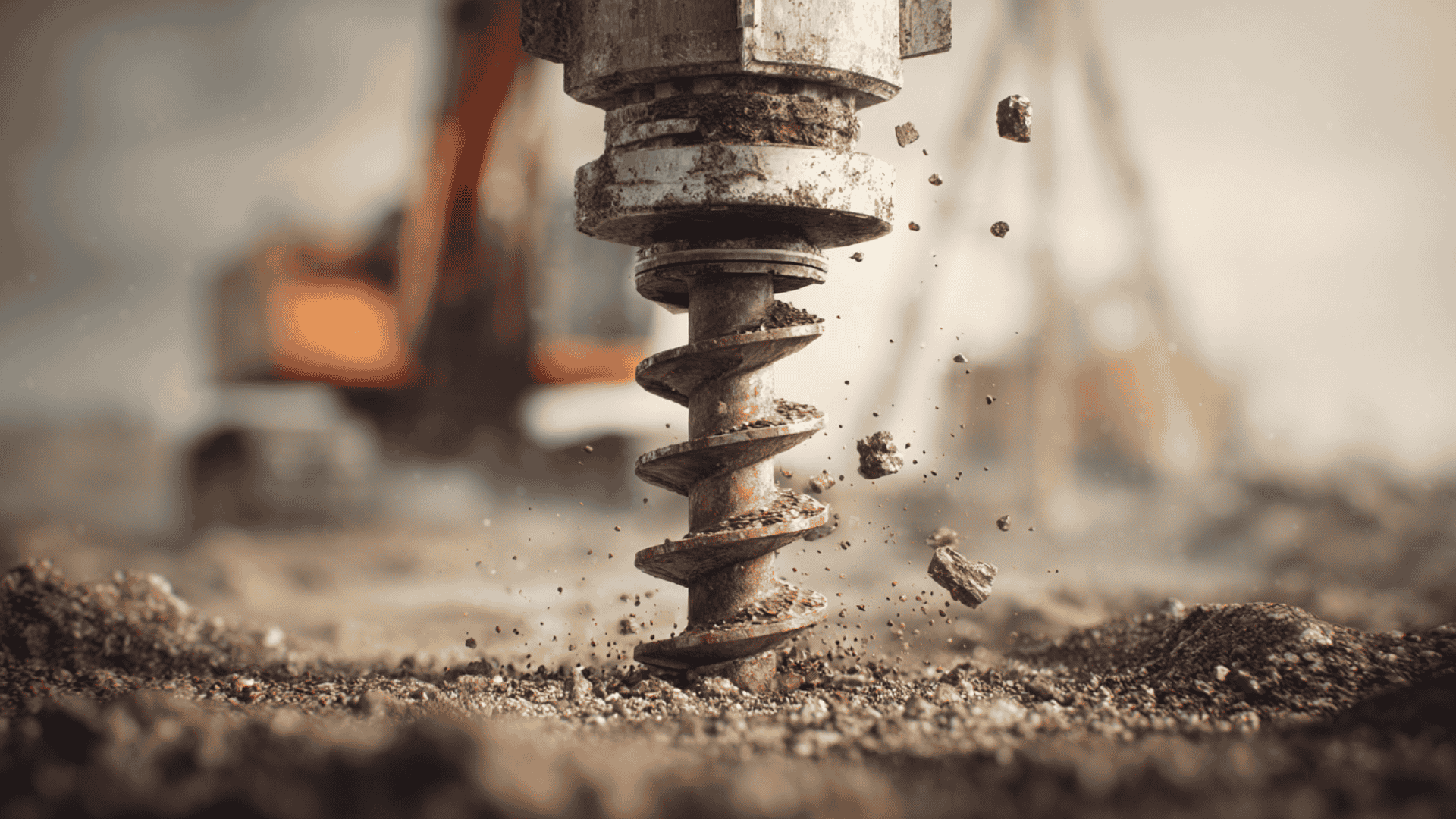
Both helical piles and concrete foundations play important roles across U.S. construction and infrastructure markets. The choice between them often depends on project type, site conditions, schedule constraints, and long-term operational requirements.
Helical Pile Applications
Helical piles are widely used in projects where speed, predictability, and minimal site impact are critical. Common applications include:
Energy and industrial infrastructure: Equipment foundations, pipe racks, and compressor stations benefit from immediate load capacity and reduced construction downtime.
Power transmission and substations: Helical piles are well-suited for structures subject to uplift and lateral loads, as well as phased or fast-track utility projects.
Marine and coastal structures: Docks, piers, and waterfront facilities benefit from low-vibration installation and minimal disturbance to sediments.
Temporary or reusable foundations: Construction staging areas, temporary facilities, and modular structures can take advantage of removability and reuse.
These applications often demand engineered, high-performance foundation systems that can adapt to complex conditions.
Concrete Foundation Applications
Concrete foundations remain appropriate for many traditional construction scenarios, particularly where conditions are favorable and schedules are flexible. Common applications include:
Large building slabs and mat foundations: Structures with broad footprints and uniform load distribution often use shallow concrete systems.
Heavy structures with extensive footprints: Industrial buildings or facilities with large, continuous foundations may favor concrete for structural integration.
Projects with stable soils and long schedules: Where subsurface conditions are predictable and time constraints are minimal, concrete foundations can be cost-effective.
In these cases, the permanence and mass of concrete can be an advantage, provided site and schedule conditions support its use.
Helical Piles vs. Concrete: Side-by-Side Comparison
Below is a practical, high-level comparison of helical piles and concrete foundations across the criteria most relevant to U.S. engineers, developers, and asset owners.
Criteria | Helical Piles | Concrete Foundations |
|---|---|---|
Installation Method | Torque-installed steel piles rotated into soil | Excavation, drilling, formwork, rebar, and concrete placement |
Excavation Required | None | Extensive excavation or drilling required |
Spoils Generation | Minimal to none | Significant soil and waste material |
Axial Load Capacity | High, engineered to site-specific soils | High, dependent on size, depth, and soil conditions |
Installation Speed | Fast; typically days | Slower; often weeks, including curing |
Weather Sensitivity | Low | High; affected by rain, heat, and freezing temperatures |
Environmental Impact | Low carbon footprint; minimal soil disturbance | High embodied carbon and site disturbance |
Adaptability in the Field | High; depth and configuration adjustable | Low; changes often require redesign |
Typical Use Cases | Energy, utilities, marine, fast-track projects | Large buildings, slabs, long-schedule projects |
TorcSill: Turnkey Helical Foundation Solutions for Modern Projects
As foundation technologies evolve, turnkey providers that offer end‑to‑end solutions are increasingly valuable, especially on complex U.S. infrastructure, energy, and industrial projects.
TorcSill is a leading specialist in engineered helical pile foundation systems, providing vertically integrated services that span engineering, manufacturing, and installation.
What TorcSill Offers:
Complete Foundation Services: TorcSill delivers full lifecycle support from geotechnical assessment and custom design to manufacturing and construction services.
Engineering & Design Expertise: Their multidisciplinary engineering teams design tailored helical pile solutions for challenging soil conditions and demanding load requirements.
ISO 9001:2015 Manufacturing: Helical piles (branded as TorcSills) are custom‑manufactured under rigorous quality and safety standards to ensure performance and durability.
Nationwide Construction Capability: With installation crews and equipment strategically positioned across the United States, TorcSill can mobilize quickly and deliver consistent results in all weather and site conditions.
Specialized Solutions Across Industries: Their foundation systems support energy, power, industrial, and marine applications, including oil & gas facilities, substations, transmission infrastructure, petrochemical plants, and coastal structures.
By integrating design, fabrication, and installation, TorcSill minimizes coordination challenges and delivers predictable performance with reduced schedule risk. Schedule a call today to get started.
Conclusion
Choosing the right foundation system is critical for project success, affecting structural performance, schedule, cost, and long-term reliability. Both helical piles and concrete foundations have proven applications, but their strengths differ based on site conditions, load requirements, and project constraints.
Looking for a Faster, Lower-Impact Alternative to Concrete Foundations?
TorcSill delivers engineered helical pile solutions with nationwide turnkey services:
Immediate load capacity with real-time verification
Minimal site disruption for sensitive or constrained locations
Custom-engineered designs for long-term performance
Discover how TorcSill can help accelerate your next foundation project. Schedule a call with our engineer today.
FAQs:
1. Can helical piles be installed in areas with strict noise or vibration restrictions?
Yes. Helical piles are mechanically screwed into the ground with minimal vibration, making them suitable for urban or sensitive environments where noise and vibration must be controlled.
2. How do soil testing requirements differ for helical piles compared to concrete foundations?
Helical piles often require targeted soil borings at pile locations for torque correlation, while concrete foundations may need extensive geotechnical mapping across the entire foundation footprint.
3. Are helical piles suitable for temporary or modular structures?
Absolutely. Helical piles can be removed or reused for phased projects, temporary buildings, or modular construction, offering flexibility that concrete foundations typically cannot provide.
4. Do helical piles reduce the need for heavy equipment on-site?
Yes. Installation requires smaller, more mobile hydraulic torque equipment, reducing site congestion and mobilization costs compared to excavation and concrete placement for traditional foundations.
5. What inspection or monitoring practices are recommended for helical piles?
Post-installation inspection focuses on verifying torque and depth against design values, unlike concrete foundations, which may require ongoing monitoring for cracks or settlement.